Can you appeal an insurance denial for breast reduction in NYC?
Yes—you can appeal an insurance denial for breast reduction in NYC, but the appeal route depends on why the request was denied and which rules govern your health plan. For a breast reduction NYC appeal in 2026, start with the written denial, match your response to the insurer’s stated reason, and verify out-of-network benefits separately; an appeal does not guarantee coverage, authorization, or reimbursement.
- A breast reduction NYC appeal should address the insurer’s exact denial reason, not simply repeat the original request.
- KPS offers breast reduction evaluation for NYC patients with out-of-network benefits; individual eligibility requires verification.
- Medical necessity, authorization, and out-of-network benefits are separate questions.
- Use the deadline in your denial notice and confirm which internal or external review process applies.
Can you appeal an insurance denial for breast reduction in NYC?
Yes. A denial is a decision you can challenge through the review process available under your plan and applicable law. Your first task is to establish whether the insurer rejected medical necessity, found missing information, applied a benefit exclusion, or denied an out-of-network claim.
KPS offers insurance-based breast reduction for patients with out-of-network benefits. Benefit verification and an individualized surgical evaluation answer different questions: whether your plan provides relevant benefits, and whether surgery is appropriate for you.
Use this sequence before submitting an appeal:
- Obtain the denial. Get the complete written notice, not only a telephone explanation.
- Identify the reason. Locate the policy provision or medical-necessity criterion the insurer applied.
- Check the deadline. Confirm the submission method and the date your appeal must arrive.
- Match the evidence. Submit records that directly address the stated reason.
- Keep confirmation. Save the appeal, attachments, delivery evidence, and insurer responses.
Why this matters
An insurance denial does not establish that breast reduction is medically inappropriate. It establishes that the insurer has not approved the request or claim under the terms it applied.
The distinction matters in NYC because a consultation location does not determine your insurance rights. A New York office visit does not, by itself, mean your employer’s health plan follows New York’s external appeal process.
Separate clinical suitability from insurance eligibility. A surgeon evaluates your symptoms, anatomy, health, and surgical goals. The insurer evaluates the submission against the applicable benefit terms and coverage criteria.
Medical-necessity denial: address the clinical criteria
A medical-necessity denial requires a response to the insurer’s medical reasoning. Ask for the breast reduction policy used for your request, including its effective date and the criteria the insurer says were not met.
For a 2026 submission, check that the policy applies to your plan and requested service. Do not rely on a policy found online without confirming that it governs your case.
Useful documentation can include:
- Your documented symptoms and their effect on daily activities.
- Examination findings recorded by your treating clinicians.
- Relevant treatment history and the response to treatment.
- The surgeon’s assessment and proposed procedure.
- An explanation of how the records address the insurer’s specific criteria.
These are documentation categories, not a universal eligibility checklist. Do not undertake treatment solely to satisfy an assumed insurance requirement; discuss clinical care with your treating clinician.
Ask the submitting office whether the denial reflects an actual failure to meet a criterion or a failure to receive the supporting record. Those problems require different responses.
Missing-information denial: correct the record
A request denied because records were missing is not necessarily a completed assessment of medical necessity. Find out exactly what the insurer did not receive and whether it accepts a corrected submission, requires a formal appeal, or uses another process.
Ask for an itemized explanation. A general request for additional documentation is less useful than a specific statement identifying the missing examination note, treatment record, or authorization information.
Keep the original appeal deadline in view while correcting the submission. Do not assume that sending additional records pauses or restarts an appeal deadline. Ask the insurer to confirm the applicable timing in writing.
Benefit exclusion: examine the plan language
A benefit exclusion raises a different issue from medical necessity. If the insurer says the requested service is excluded, ask for the exact plan language and an explanation of how it applies to your request.
Clinical evidence alone does not create a benefit that the plan excludes. The relevant question is whether the insurer applied the exclusion correctly, including whether it classified the requested procedure accurately.
Request the governing plan document or insurance contract, not only a short benefits summary. For an employer-sponsored plan, the plan administrator can help identify the controlling documents and the applicable review process.
Out-of-network denial: verify the benefit separately
An out-of-network benefit does not automatically mean every service from an out-of-network surgeon is covered. The procedure must still satisfy the plan’s applicable benefit terms, medical-necessity requirements, and authorization rules.
KPS breast reduction care is relevant to NYC patients seeking evaluation with out-of-network insurance benefits. An out-of-network benefit is a starting point for verification, not a promise of payment.
Ask whether the denial concerns the procedure itself, the surgeon’s network status, a facility, an authorization requirement, or claim processing. Also confirm whether the surgeon, facility, and anesthesia services require separate benefit checks.
A successful medical-necessity appeal does not, by itself, settle every payment question. Request a written explanation of the decision’s scope and any remaining conditions.
Which review route fits your denial?
Internal appeals and external reviews serve different functions. Start with the instructions in your denial notice rather than choosing a route based only on your location.
| Review route | Best for | What it does | Main limitation |
|---|---|---|---|
| Internal appeal | Challenging the insurer’s initial decision | Asks the plan or insurer to reconsider the denial | The appeal still operates under the plan’s terms |
| External review | An eligible denial requiring independent review | Sends an eligible dispute to a reviewer outside the insurer | Not every denial qualifies; jurisdiction and deadlines matter |
| Corrected submission | Resolving an identified submission error | Supplies or corrects information through the insurer’s designated process | It does not automatically replace or extend an appeal |
For many health plans subject to federal claims-and-appeals rules, you have at least 180 days to request an internal appeal after receiving a denial. The U.S. Department of Labor's health-benefit claims guidance explains this protection for applicable employer health plans; confirm the rules governing your own coverage.
For an eligible New York external appeal, the New York State Department of Financial Services generally requires a patient application within 4 months of the final adverse determination. This is not a universal deadline for every plan, every denial, or every applicant.
For a denial received in 2026, follow the notice’s instructions and confirm the current requirements with the responsible plan or regulator. Do not calculate your deadline from a general article alone.
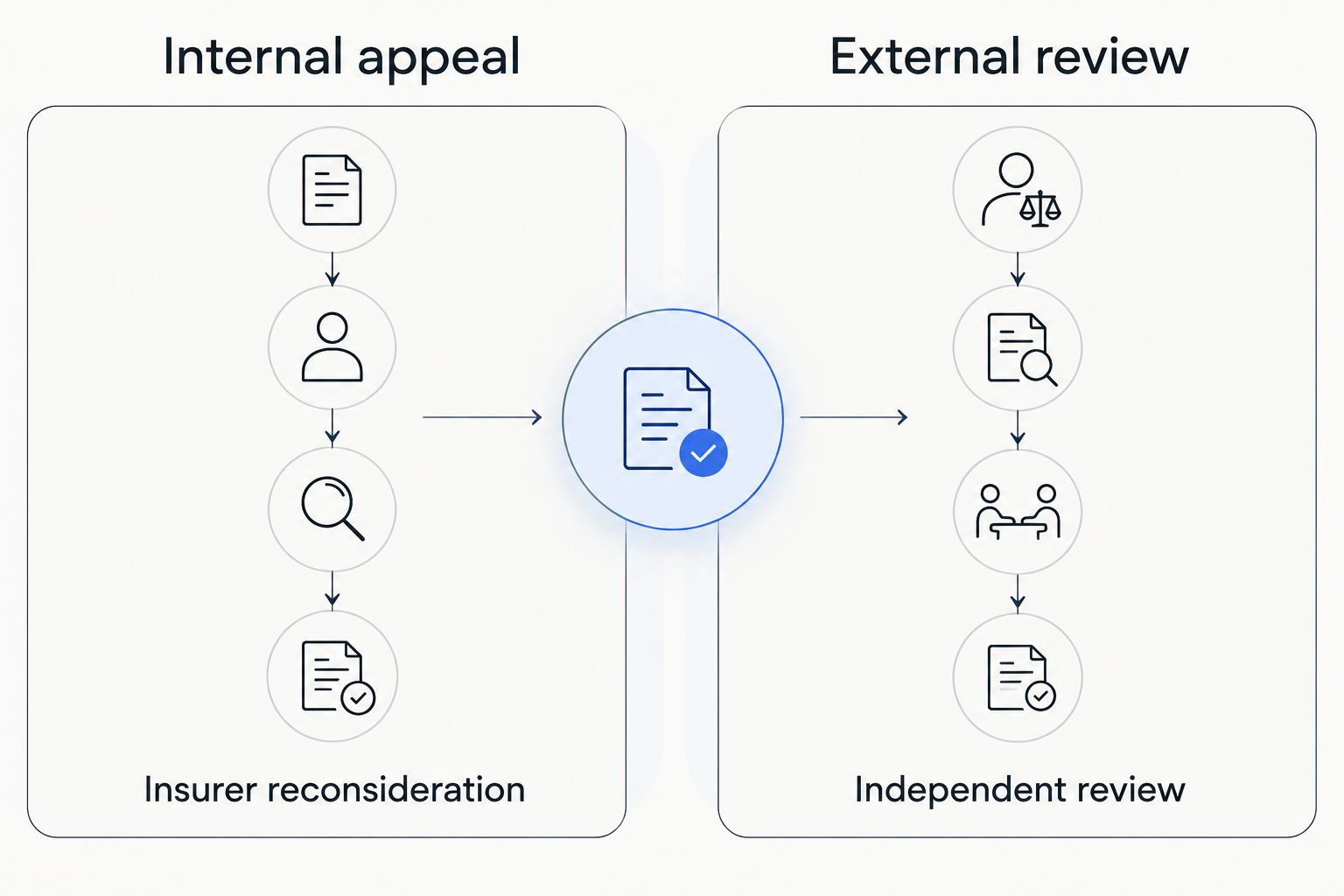
Why breast reduction appeal requirements vary
The same operation can produce different insurance decisions because the governing benefits and submitted records differ. These factors determine what your appeal needs:
- Plan terms: Coverage provisions and exclusions define the benefits being considered.
- Denial reason: Missing records, medical necessity, and network restrictions require different responses.
- Clinical documentation: The insurer evaluates the records submitted, not symptoms that were never documented.
- Network benefits: Out-of-network coverage requires its own verification.
- Plan jurisdiction: State-regulated coverage and self-funded employer plans do not necessarily use the same external review system.
- Request stage: A denial before surgery and a claim denial after surgery involve different records and procedural questions.
Ask the insurer to identify your plan type. An insurance company’s name on your card does not establish whether the company insures the benefit or administers a self-funded employer plan.
How do you write a useful appeal letter?
A useful appeal letter connects the denial reason to the supporting record. Keep the argument specific and make the attachments easy to locate.
Identify the decision
Include the patient and member information requested by the insurer, the denial reference, the service under review, and the date of the decision. State whether you are appealing a pre-service request or a processed claim.
Avoid sending sensitive health information through an unverified email address. Use the submission channel identified by the insurer.
Answer the stated reason
Summarize the insurer’s reason accurately, then explain why you are requesting reconsideration. Refer to the relevant plan language or medical criterion and identify the attached evidence supporting your response.
A symptom description and a clinician’s medical assessment serve different purposes. Your account explains your experience; the clinical record supports the medical evaluation.
Request a clear response
Ask for reconsideration and a written decision explaining the outcome. If the insurer maintains the denial, request the next available review instructions and the criteria or documents supporting its decision.
Keep a complete copy of the submission. For a 2026 appeal file, record dates consistently across the denial, correspondence, and delivery confirmation so the sequence remains clear.
What should you ask before an NYC consultation?
Bring the denial notice, insurance card, relevant benefit documents, and available clinical records. Tell the office whether you are seeking an initial evaluation, help understanding an existing denial, or clarification after a claim decision.
Ask how the practice handles benefit verification and what information you need to obtain yourself. Do not assume that a consultation includes representation in every insurance dispute or external appeal.
You can read about the practice before arranging an evaluation. KPS offers breast reduction care, but your surgical suitability and insurance eligibility require separate, patient-specific assessment.
Can you appeal before having breast reduction surgery?
Yes—a pre-service denial can be appealed through the applicable plan process. Confirm whether authorization is required and whether the appeal concerns medical necessity, benefit eligibility, or another issue before deciding how to proceed.
Do not interpret an appeal submission as authorization to undergo surgery. Ask for the insurer’s written decision and discuss unresolved coverage questions before making a surgical commitment.
Does winning an appeal mean insurance pays everything?
No—a successful appeal does not establish that every related expense is payable. Deductibles, coinsurance, network provisions, allowed amounts, and separately billed services can still affect your responsibility under the plan.
Ask what was approved, which providers and services the decision covers, and what conditions remain. Keep the approval alongside the benefit verification rather than treating either document as a complete payment guarantee.
Can your surgeon help with the appeal?
Your surgeon can provide relevant clinical documentation and explain the medical assessment. Ask the office which appeal materials it provides and whether your plan requires permission for someone to act as your representative.
The treating clinician’s role is to document an accurate clinical picture, not to promise an insurer’s decision. KPS does not establish your eligibility simply by offering an insurance-based breast reduction pathway.
FAQ
Can I appeal a breast reduction denial if I have out-of-network benefits?
Yes, you can challenge the denial through the review process available under your plan. Out-of-network benefits do not remove medical-necessity requirements, exclusions, or authorization rules.
How long do I have to appeal a breast reduction denial?
For many plans subject to federal claims-and-appeals rules, you have at least 180 days to request an internal appeal after receiving the denial. Check your notice and confirm the rules for your particular plan.
Can I request a New York external appeal?
You can request a New York external appeal when your coverage and denial meet the state program’s eligibility requirements. Eligible patient applications generally must be filed within 4 months of the final adverse determination; confirm the applicable deadline and process.
What if the insurer says breast reduction is cosmetic?
Ask for the exact policy language and the clinical criteria used to classify the request. An appeal should explain how the documented medical circumstances address those criteria rather than relying only on the procedure’s name.
Do I need to repeat treatment before appealing?
Do not repeat treatment solely because you assume insurance requires it. Obtain the applicable criteria and discuss appropriate care and documentation with your treating clinician.
Is authorization the same as guaranteed reimbursement?
No, authorization is not a guarantee of reimbursement. Payment remains subject to applicable plan terms, eligibility, claim processing, and the scope of the authorization.
One last thing
Ask whether a new submission affects your existing appeal deadline before sending it. Correcting a missing record and formally appealing a denial are not automatically the same action.
For breast reduction planning in 2026, the useful next step is a precise one: identify the denial reason, confirm the governing benefit, and assemble evidence that answers that reason. You do not need a more forceful letter; you need a better-matched submission.
Published by KPS. Author: Not identified. Medical review: No named medical reviewer. This article provides general education, not individualized medical or legal advice.
Related guides
Can you plan breast reduction in NYC before a pregnancy?
Yes, you can plan breast reduction in NYC before a future pregnancy, but the right timing depends on your current discomfort, pregnancy plans, and how important breastfeeding is to you. Pregnancy can change the size and shape of your chest after surgery, and breast reduction can affect milk production. A consultation helps you weigh relief now against the possibility of later changes, without committing you to an operation.
- Planning breast reduction in NYC before pregnancy starts with your symptoms, family plans, and breastfeeding goals.
- Pregnancy can change chest size and shape after breast reduction; surgery does not prevent those changes.
- Breast reduction can affect milk production, and future breastfeeding cannot be guaranteed.
- Kiwanuka Plastic Surgery centers consultation on your anatomy, comfort, goals, and concerns.
Why this matters
You do not have to put off a conversation about chest discomfort simply because pregnancy is part of your future. Planning and scheduling surgery are separate decisions. You can explore what breast reduction involves while leaving room for your family plans to develop.
At Kiwanuka Plastic Surgery, we approach that conversation around what matters to you: comfort, natural proportions, daily activity, and long term well being. Our guide to what to bring to a breast reduction consultation in NYC can help you organize your questions before meeting with us.
Can you plan breast reduction in NYC before a pregnancy?
Yes. A future pregnancy does not automatically mean you need to postpone breast reduction. The central question is whether surgery now fits your symptoms and priorities, knowing that pregnancy can alter the result and surgery can affect breastfeeding.
A useful planning conversation follows these steps:
- Describe your current discomfort. Explain how chest weight affects your neck, shoulders, skin, exercise, clothing, or everyday activities. Include what you have already tried for relief.
- Share your pregnancy plans. Tell your surgeon whether you are actively trying to conceive, expect to try soon, or are considering pregnancy without a set timeline.
- Discuss breastfeeding directly. Explain whether breastfeeding is a priority, something you hope to try, or an uncertainty you want help understanding.
- Review the operation and its tradeoffs. Ask about the proposed technique, scars, changes in sensation, healing, and implications for milk production.
- Agree on the next decision. That might mean continuing surgical planning, waiting until after pregnancy, or returning when your plans are clearer.
You do not need a settled answer to every question before your appointment. The purpose of consultation is to make those decisions with a clearer understanding of your own circumstances.
Planning surgery before pregnancy
Having breast reduction before pregnancy lets you address symptoms rather than waiting for a future milestone. Breast reduction, also called reduction mammaplasty, removes excess tissue to reduce chest size and weight. That can matter when discomfort is already interfering with movement, sleep, or daily routines. Surgery still involves recovery, scars, and risks that deserve careful discussion.
The main limitation is that your result is not protected from pregnancy related changes. Chest volume, skin, and shape can change during pregnancy and after breastfeeding. A result that feels balanced before pregnancy can look or feel different afterward.
Planning breast reduction before pregnancy means accepting that your body will continue to change after surgery. Ask your surgeon how those possible changes affect the goals you are setting now. No consultation can predict your exact future shape or promise that you will never want another procedure.
Planning surgery after pregnancy
Waiting until after pregnancy gives your surgeon the opportunity to assess your chest after pregnancy related changes have occurred. If you plan to breastfeed, waiting also avoids introducing breast reduction related changes to milk production before that pregnancy.
The tradeoff is living with your current symptoms for longer. Waiting is not automatically the better decision when discomfort already affects your quality of life, especially if pregnancy remains an open ended possibility.
If you have recently given birth or are breastfeeding, tell your surgeon. Surgical planning needs to account for milk production, changes in chest size, your health, and the practical support you will have during recovery. Your surgeon should explain when an assessment is useful and what needs to settle before surgery is scheduled.
Why the right timing varies
Breast reduction timing depends on more than whether pregnancy appears somewhere in your plans. These factors help make the decision personal rather than automatic:
- Your symptoms now. The effect of chest weight and discomfort on daily life belongs at the center of the conversation.
- How close pregnancy feels. Actively trying to conceive calls for a different discussion from considering pregnancy without a timeline.
- Your breastfeeding priorities. Surgery can affect milk production, so this goal needs attention before you consent.
- Your anatomy and surgical plan. The amount and location of tissue removal, incision pattern, and handling of the nipple and areola matter to the discussion.
- Your recovery support. Work, caregiving, transportation, and help at home influence when recovery is practical.
- Your comfort with future changes. Pregnancy can change the result even when surgery and healing proceed as planned.
There is no single sequence that removes every tradeoff. Together, we will discuss which concerns carry the most weight for you.
Can you breastfeed after breast reduction?
Breastfeeding can be possible after breast reduction, but a full milk supply is not guaranteed. Surgery can affect the milk ducts, nerves, and glandular tissue involved in milk production and delivery. The effect depends in part on the operation and your individual anatomy.
The Centers for Disease Control and Prevention guidance on breast surgery and breastfeeding explains that previous surgery can affect milk production and that babies need monitoring for adequate weight gain. If you become pregnant after reduction, tell your pregnancy care team about the surgery. A lactation consultant, a professional who helps with breastfeeding and milk supply, can help you plan support before birth and during postpartum recovery.
What the research tells us
A 2017 systematic review in PLOS ONE examined 51 observational studies covering 31 distinct breast reduction techniques worldwide. The review found better breastfeeding outcomes with techniques that preserved the tissue connections between the nipple and the chest wall.
Only 22 studies defined breastfeeding success, and those definitions ranged from 1 to 24 weeks of breastfeeding. The authors did not combine the studies into a single overall success rate because surgical techniques and outcome definitions differed substantially. These figures explain why a general breastfeeding success percentage cannot predict your milk supply or ability to breastfeed exclusively after surgery; they are not Kiwanuka Plastic Surgery patient outcomes.
Before surgery, ask your surgeon:
- How does the proposed technique affect the tissues involved in breastfeeding?
- Will the nipple and areola remain attached to underlying tissue?
- What uncertainty remains even with the planned technique?
- What information should you share with your future maternity and lactation care team?
A technique intended to preserve important connections does not guarantee a particular breastfeeding outcome. Your decision should reflect that uncertainty, not a promise of future milk supply.
Will pregnancy undo a breast reduction?
Pregnancy can change the result of breast reduction, but it does not mean every surgical change disappears. Your chest can increase in volume, lose volume afterward, or develop changes in skin and shape. The extent of those changes differs from person to person.
Some patients remain comfortable with their proportions after pregnancy. Others want to discuss further surgery once their body has settled. Neither outcome can be predicted for you in advance.
A more useful question than whether pregnancy will undo surgery is: Would relief now still matter to you if your chest changed later? That question connects the surgical decision to your daily life rather than asking for certainty your body cannot provide.
What we will discuss at your consultation
Your breast reduction consultation should include both what you want to change and what you want to preserve. Bring questions about comfort, proportion, sensation, breastfeeding, scars, and the activities that matter to you. Tell us about previous surgery, current medicines, pregnancy plans, and any relevant health concerns.
At Kiwanuka Plastic Surgery, breast reduction planning centers on your anatomy, comfort, and pregnancy goals. We will discuss what surgery is intended to address, its limitations, and the recovery responsibilities you would be taking on.
Scar care and healing belong in that discussion from the beginning. Ask where incisions are expected, how you will care for them, and which changes should prompt a call to the practice. Scars are part of breast reduction, and their appearance changes during healing without a guaranteed final appearance.
If you care for a child, explain what your usual day involves. Lifting, carrying, and household responsibilities need to be considered when planning help during recovery. Your postoperative instructions should guide your activity rather than a general timeline found online.
Discuss your breast reduction plans
Talk through pregnancy timing, breastfeeding goals, comfort, and recovery at your consultation.
What you pay
Pregnancy plans alone do not establish whether insurance covers breast reduction. Coverage depends on your plan, medical necessity requirements, and the proposed care. An approval also needs to be understood alongside your deductible, coinsurance, and other patient responsibilities.
Our breast reduction arrangement uses an out of network surgeon and an in network surgical facility. We will discuss your benefits and eligibility, including federal surprise billing protections for covered care when they apply. You should not assume that ordinary out of network benefits are always required or that coverage is guaranteed.
Our explanation of how out of network benefits work for breast reduction in NYC can help you prepare questions about coverage. Ask for a clear explanation of what your plan covers and what you would be responsible for before making a surgical commitment.
FAQ
Should I wait until after having children to get breast reduction?
You do not automatically need to wait until after having children. The decision depends on your current symptoms, pregnancy timeline, breastfeeding goals, and acceptance of possible changes after pregnancy.
Can I have a breast reduction consultation if I am not sure about pregnancy?
Yes, you can have a breast reduction consultation while your pregnancy plans are uncertain. Share what you know and what remains undecided so the discussion reflects your priorities without forcing a surgical commitment.
How long after breast reduction should I wait to try to conceive?
Your surgeon and pregnancy care clinician should help you decide when to try to conceive after breast reduction. The advice needs to account for healing, your health, medicines, and any concerns during recovery.
Does breast reduction mean I cannot breastfeed?
Breast reduction does not always prevent breastfeeding, but it can reduce milk production. Discuss the proposed technique before surgery and seek breastfeeding support during a future pregnancy if breastfeeding matters to you.
Will I need another breast reduction after pregnancy?
Another breast reduction is not automatically necessary after pregnancy. Pregnancy can change chest volume and shape, and any later decision depends on your symptoms, anatomy, and preferences.
Can insurance cover breast reduction before I have children?
Insurance can cover breast reduction before you have children when your plan’s coverage and medical necessity requirements are met. Benefits and eligibility need to be confirmed for your proposed care; future pregnancy plans do not establish approval.
What if I become pregnant while planning breast reduction?
Tell your surgical team promptly if you become pregnant while planning breast reduction. Elective surgery is generally postponed during pregnancy, and your care team can help you revisit timing afterward.
One last thing
Before your consultation, write down what you hope would feel different in an ordinary day. That might be walking more comfortably, finding supportive clothing, or exercising without chest discomfort. Then write down what concerns you most about pregnancy, breastfeeding, or scars.
Bring both lists. The right plan needs to respect your life now as well as the future you are considering.
Related guides
How should NYC patients choose breast implant size and profile?
Choose breast implant size and profile by starting with your measurements, existing tissue and the shape you want, rather than a cup size alone. The right choice balances implant width, forward projection and volume with what your body can comfortably support.
- For breast augmentation in NYC, measurements guide implant choices alongside your personal goals.
- Implant volume describes size; profile describes how far the implant projects forward.
- The same implant volume can look different on different bodies.
- 3D imaging supports discussion but cannot promise your surgical result.
How should you choose breast implant size and profile?
Begin with what you want to see and feel, then connect those goals to your anatomy. You might want a subtle change, more fullness above the nipple, a different silhouette in clothing or volume restored after pregnancy. These are useful starting points for a breast augmentation consultation in NYC.
At Kiwanuka Plastic Surgery, we discuss those preferences alongside your breast dimensions, chest wall, skin quality and existing tissue. Dr. Elizabeth Kiwanuka uses measurements and 3D imaging to explain the choices that fit your frame.
A useful implant recommendation explains why the dimensions suit you, not simply which volume to choose.
For context, the American Society of Plastic Surgeons reported 306,196 breast augmentation procedures in the United States in 2024 in its June 2025 statistics announcement. That national procedure count is not an NYC estimate or a guide to which implant size suits you. Your own measurements and preferences remain the starting point.
What is the difference between size and profile?
Implant volume is measured in cubic centimeters, often written as cc. Implant projection describes how far an implant extends forward from its base and is central to its profile. Base width, also called base diameter for a round implant, describes how wide the implant is across its base.
For breast augmentation in NYC, implant sizing is a conversation about these dimensions together, not a search for one ideal cc number. Upper pole fullness means fullness in the upper part of the breast, above the nipple. Describing whether you prefer a subtle slope or more fullness there can help us understand your goals.
These measurements work together. Two implants with the same volume can have different widths and profiles, so the volume alone does not tell you the shape.
| Measurement | What it describes | What to discuss |
|---|---|---|
| Volume | The amount of space inside the implant | How much additional fullness you want |
| Base width | The width of the implant across its base | How the implant fits your breast dimensions |
| Profile | How far the implant projects forward | How the side view fits your goals |
You may hear terms such as low profile, moderate profile, moderate plus, high profile and ultra high profile. The ASPS explanation of breast implant profiles, published in August 2016, explains that implants of the same volume can have different widths and levels of projection.
Profile names vary between implant manufacturers. Comparing the actual dimensions is more informative than assuming a label means the same thing across every implant range. Neither moderate profile nor high profile is automatically the right choice for a natural appearance.
Does a higher profile always mean a larger result?
No. Profile and volume describe different things. At the same volume, a narrower implant can project farther forward than a wider implant.
A higher profile is not automatically more natural or less natural. The appearance depends on the implant dimensions, your tissue coverage and the rest of the surgical plan. We will discuss the front and side views together so one measurement does not carry the whole decision.
Why your starting anatomy matters
The same implant does not produce the same result on every person. Your existing shape remains part of the plan, even when you are adding volume.
The consultation considers:
- Breast width and chest shape. These help establish the dimensions that fit your frame.
- Existing tissue and soft tissue coverage. The skin, fat and breast tissue over an implant influence how its edges and contour appear.
- Skin quality. The skin envelope affects how added volume is supported.
- Nipple position and skin excess. These help determine whether augmentation alone addresses your goals.
- Differences between sides. Existing asymmetry needs discussion before selecting implants.
Your measurements guide the choices, but they do not replace your preferences. Together, we discuss where your goals and anatomy align and where a compromise would be more appropriate.
Can you choose an implant by bra cup size?
A cup size is a way to describe your wishes, not a precise surgical measurement. Bra sizes vary between brands, and your existing tissue contributes to the final fit.
If you have a preferred cup size, bring it into the conversation. Then describe what matters about that size. Is it the amount of fullness, the way a particular top fits, or how your proportions look from the side?
Reference photographs can help explain those preferences. They cannot establish which implant will reproduce another person's result, because your starting anatomy is different.
You do not need to arrive knowing your implant size. You need room to explain what matters to you.
How does 3D imaging help you decide?
At Kiwanuka Plastic Surgery, Crisalix 3D imaging lets you review approximate changes on a model of your own body. Comparing options side by side can make the discussion about size and profile easier to understand.
Use the images to ask specific questions. Which option changes the side view? Which creates the fullness you prefer? Does the simulation reveal a preference you found difficult to describe?
The simulation is a planning tool, not a promise. It cannot guarantee softness, exact symmetry, scar appearance or the way your tissues will heal. Your examination and the surgeon's assessment remain essential.
When is an implant alone not the whole answer?
Added volume does not address every concern about breast shape. If your main concern is skin excess or nipple position, a discussion about lifting and reshaping may be more useful than simply increasing implant size.
We will explain whether your goals call for augmentation alone or a different plan. You can also read about breast lift surgery when considering how position and volume affect your preferred shape.
Hybrid augmentation combines an implant with your own fat to refine contour in selected patients. It is another planning option, not a requirement for a natural appearance or a substitute for choosing suitable implant dimensions.
Include healing and future care in your decision
Choosing an implant also means understanding the procedure and its continuing care. In its breast implant risks and complications guidance, updated in December 2023, the FDA explains that breast implants are not lifetime devices. Further surgery can be needed, and no size or profile removes the possibility of complications.
Discuss infection, bleeding, changes in sensation, implant rupture and capsular contracture, which is tightening of scar tissue around an implant. Ask which risks apply to your proposed implant and placement, and how you should monitor the implants afterward.
For silicone gel breast implants, the FDA screening schedule described in ASPS breast implant safety guidance, updated in March 2023, starts with ultrasound or MRI 5 to 6 years after placement, then repeats every 2 to 3 years, even without symptoms. These are rupture screening intervals, not a recommended implant replacement date. New symptoms need assessment rather than waiting for a routine scan.
Silicone gel implants and saline implants both have a silicone outer shell, but their contents differ. We will discuss how the proposed implant's filling, dimensions and monitoring needs fit your preferences and care plan.
We also discuss incision placement and scar care. A smaller desired change does not mean there will be no scar, and a simulation cannot predict your scar's final appearance. For more on this part of planning, read why the scar starts with the incision.
Questions to bring to your consultation
You can make the discussion practical without deciding everything in advance:
- Which implant dimensions fit my measurements, and why?
- What would change if I chose more or less projection?
- What can augmentation change, and what would require a lift?
- How does my existing tissue affect the expected contour?
- What are the limits of the 3D images we are reviewing?
- What follow up and implant monitoring will I need?
If two options feel close, explain what still feels uncertain. A consultation should help you understand the differences rather than leave you choosing between numbers without context.
FAQ
Can I choose the same implant size as someone in a photograph?
You can use a photograph to explain your preferred shape, but the same implant does not produce the same result on different bodies. Your existing tissue and measurements guide the recommendation.
Does high profile mean a bigger implant?
No. Profile describes forward projection, while volume describes how much space the implant contains. Compare both with base width to understand the proposed shape.
Can you guarantee my final cup size?
No. Bra sizing varies and your starting anatomy affects the result. We discuss proportions and visible changes rather than promise a specific cup size.
Will 3D imaging show my exact surgical result?
No. Crisalix provides an approximation for discussion. It cannot guarantee the final shape, feel, symmetry or healing.
Can implants replace a breast lift?
Not in every situation. When skin excess or nipple position is the main concern, your consultation should address whether a lift belongs in the plan.
Do smaller implants eliminate surgical risks?
No. Implant size does not remove risks such as infection, rupture or changes in sensation. Your surgeon will explain the risks and follow up associated with your individual plan.
Your choice is more than a number
Before settling on a volume, ask yourself whether you understand why the recommended dimensions fit your anatomy and goals. That explanation matters more than choosing the same number as someone else.
At Kiwanuka Plastic Surgery, breast augmentation planning is a collaborative conversation about proportion, comfort and healing. You can bring your preferences and questions without arriving with the answers already decided.
This article provides general education and does not replace an individual medical consultation.
Related reading
How do deductibles affect breast reduction costs in NYC?
Your remaining deductible affects how much you pay toward covered breast reduction in NYC before your plan begins sharing costs for services subject to that deductible. Meeting it does not necessarily end your expenses, because coinsurance, copayments, and services your plan does not cover can still affect your responsibility.
- For breast reduction in NYC, check your remaining deductible, not just the annual amount listed in your plan.
- Kiwanuka Plastic Surgery offers insurance based breast reduction; coverage and your share require individual confirmation.
- Approval does not mean every charge is paid, and meeting your deductible does not eliminate all cost sharing.
- Confirm how the surgeon and surgical facility claims will apply to your benefits before scheduling.
How do deductibles affect breast reduction costs in NYC?
The amount left on your deductible matters more than the original annual deductible. If you have already paid toward it through other covered care, you have less remaining to meet. If little has been applied, more of your covered surgical care can become your responsibility before your plan starts sharing those expenses.
The deductible that applies also matters. Your plan can treat the surgeon and surgical facility differently. Our guide to how out of network benefits work for breast reduction in NYC explains the coverage questions to discuss alongside your deductible.
To understand your likely responsibility, start with these steps:
- Check your remaining deductible. Ask your insurer for the amount still unmet, rather than relying on the annual figure on your benefits summary.
- Confirm which benefits apply. Ask how the planned surgeon and facility claims will be processed.
- Check what comes after the deductible. Coinsurance means you pay a percentage of the covered amount; a copayment is a fixed amount assigned by your plan.
- Ask for a written estimate. Confirm what it includes and whether any services will be billed separately.
An estimate helps you plan. The final amount depends on the care provided and how your insurer processes the claims.
Why this matters
Breast reduction planning includes your comfort, your goals, and your ability to prepare financially. A deductible is only one part of that conversation. Looking at it alone can leave you with an incomplete picture of what you will pay.
You do not need to become an insurance expert before your consultation. Bring your questions and benefit information so we can discuss the next steps together, including what needs confirmation from your insurer.
What you pay
Your remaining deductible
Your deductible is the amount you pay for covered services subject to it before your insurance begins sharing those costs. Some services have different rules, so the deductible does not apply identically to every medical bill.
For context, KFF's 2025 Employer Health Benefits Survey found that 88% of workers with single coverage had a general annual deductible. Among workers with single coverage and a general annual deductible, the average was $1,886. These are national figures for employer sponsored insurance, not breast reduction prices, NYC estimates, or a prediction of your remaining deductible.
Ask your insurer whether recent claims have finished processing. Care you already received might not yet appear in the deductible balance you see online. Use the most current information available when reviewing an estimate.
Coinsurance and copayments
Meeting your deductible does not automatically mean your remaining covered care has no patient cost. Your plan can still require coinsurance or a copayment.
Coinsurance is generally calculated using the allowed amount, the amount your plan recognizes for a covered service, rather than simply the provider's billed charge. HealthCare.gov explains how coinsurance works. When reviewing your breast reduction insurance coverage, ask which allowed amount and coinsurance rate the estimate uses.
Ask what you owe after the deductible, not only whether you have met it. This is especially useful when an estimate includes several parts of surgical care rather than the surgeon's services alone.
Your out of pocket maximum
Your out of pocket maximum is a separate limit on what you pay for covered care under your plan's rules. Eligible deductible payments, copayments, and coinsurance generally count toward that limit.
It is not a limit on every possible expense. Premiums and services your plan does not cover generally do not count, and out of network expenses can have different rules. Ask which planned charges count toward your limit.
Which deductible applies to your surgery?
Kiwanuka Plastic Surgery's breast reduction care uses an out of network surgeon and an in network surgical facility. The surgeon's network status alone does not tell you which cost sharing rules apply to every part of your care.
For covered care at an in network surgical facility, federal surprise billing protections can limit certain out of network charges to your in network cost sharing. CMS explains your billing rights when using insurance, including situations where signing a notice and consent form can waive those protections. These protections do not eliminate your deductible or guarantee coverage for the procedure. Your benefits, the planned services, and the protections that apply need individual confirmation.
Do not assume that ordinary out of network benefits are always required. Equally, do not assume that an in network facility makes every service covered. The useful question is how your insurer will process your specific planned care.
Why your responsibility varies
Two patients having breast reduction can have different insurance responsibilities without either estimate being incorrect. These factors explain why:
- Your remaining deductible. Prior covered care affects how much is still unmet.
- The benefits applied to each claim. Surgeon and facility services need confirmation rather than an assumption based on one provider's network status.
- Your cost sharing after the deductible. Coinsurance and copayments can continue after you meet it.
- Your remaining out of pocket maximum. Eligible expenses already paid can affect your responsibility for later covered care.
- Your plan year. Deductibles and spending limits usually reset at the start of a new plan year, which is not necessarily the calendar year.
- Coverage for the planned services. An uncovered service is different from a covered service applied to your deductible.
How we help
More than 95% of submitted insurance requests at Kiwanuka Plastic Surgery are approved. That practice approval rate does not guarantee individual approval or determine what your plan will pay.
Our breast reduction consultation is a conversation about what matters to you, including chest discomfort, your goals, your anatomy, and your concerns about surgery. Insurance questions belong in that conversation, alongside healing and scar care.
Bring your insurance card, any relevant coverage correspondence, and the questions you want answered. Our team can help you understand what needs clarification before you commit to a surgical plan. Your insurer should confirm your current benefits, remaining deductible, and expected cost sharing.
Discuss your breast reduction questions
Talk with our team about consultation planning and the insurance details that need confirmation.
Does insurance approval mean I have met my deductible?
Insurance approval, often called prior authorization, does not mean you have met your deductible. Approval addresses coverage for the requested care; your deductible balance reflects eligible expenses applied under your plan.
Ask for both pieces of information separately. A procedure can be approved while you still have a deductible and other cost sharing to pay.
Will separate bills mean separate deductibles?
Separate bills do not automatically mean separate deductibles. Claims processed under the same deductible can contribute to the same balance, while different benefits can carry different rules.
Ask whether the estimate includes the surgeon, surgical facility, anesthesia, and any other planned services. Knowing who will bill you helps you ask the right coverage questions without assuming each bill starts a new deductible.
Should I schedule surgery after meeting my deductible?
Meeting your deductible can affect your responsibility, but it should not be the only reason you choose a surgery date. Allow time for medical planning, any required authorization, and recovery arrangements that fit your life.
If your proposed date is near a plan year change, confirm when your benefits reset and whether coverage or authorization details need updating. An estimate based on your current deductible balance does not necessarily apply after that reset.
FAQ
Does my deductible apply to breast reduction in NYC?
Your deductible can apply to covered breast reduction in NYC, depending on your plan and how the services are processed. Confirm which deductible applies and how much remains before relying on an estimate.
Will I owe anything after meeting my deductible?
You can still owe coinsurance, copayments, or charges for services your plan does not cover after meeting your deductible. Ask your insurer how your remaining out of pocket maximum affects covered care.
Do I need out of network benefits for breast reduction?
Out of network benefits are not always required for every covered breast reduction arrangement. For an out of network surgeon at an in network surgical facility, confirm your benefits and whether federal surprise billing protections apply.
Does insurance authorization guarantee payment?
Insurance authorization does not guarantee payment or eliminate your share of covered expenses. Your benefits and the insurer’s processing of the final claims still affect your responsibility.
Can other medical appointments count toward my deductible?
Other medical appointments can count toward your deductible when they are covered and subject to that deductible. Check your processed claims rather than assuming every appointment payment counts.
What should I do if my bill does not match my estimate?
Compare the bill with your insurer’s explanation of benefits (EOB), which shows how the claim was processed. Ask the billing office and insurer to clarify any difference before assuming the amount is correct.
What insurance information should I bring to my consultation?
Bring your insurance card, relevant coverage correspondence, and any available deductible information. Include questions about the surgeon, surgical facility, and other planned services so each part can be addressed.
One last thing
Ask which deductible balance an estimate uses and when that balance was checked. An estimate built around an outdated balance can be confusing even when the coverage explanation is otherwise correct.
At Kiwanuka Plastic Surgery, breast reduction planning brings your goals and practical questions into the same conversation. You deserve to understand both your care plan and the financial details that still need confirmation.
Related guides
How should NYC patients discuss breast reduction size goals?
Discuss breast reduction size goals by describing how you want your chest to feel, the activities you want to enjoy more comfortably, and the proportions that feel right for your body. A preferred cup size can help begin that conversation, but it does not define the surgical plan or guarantee a result. Your consultation brings your preferences together with an assessment of your anatomy, tissue health, and healing.
- For breast reduction in NYC, discuss comfort, size, shape, and lifestyle together rather than choosing a cup letter alone.
- Kiwanuka Plastic Surgery includes a lift with every breast reduction, addressing shape as well as volume.
- Your anatomy and tissue health help determine the reduction that can be planned safely.
- Bring questions about scars, sensation, breastfeeding, recovery, and insurance so the plan reflects what matters to you.
How should NYC patients discuss breast reduction size goals?
Begin with what you hope will feel different in daily life. Then describe the shape and proportions you have in mind. You do not need to arrive with a final size decision or know which surgical technique you need.
Our guide to preparing for a breast reduction consultation in NYC can help you organize your questions and medical information before your visit.
- Describe your experience. Share any heaviness, shoulder discomfort, skin irritation, clothing difficulties, or limitations with exercise. Explain what you notice and when it affects you.
- Name your priorities. Feeling lighter, moving more freely, preserving fullness, and creating a more balanced shape are different goals. Tell us which matter most to you.
- Explain your preferred appearance. A cup size or reference photograph can be a starting point. Describe what you like about the proportions rather than expecting an identical result.
- Ask how your anatomy shapes the plan. Discuss the amount of reduction, the lift, and the considerations that protect healthy tissue.
- Talk through the whole experience. Include scars, healing, sensation, recovery, and financial questions, not only the intended size change.
Why this matters
A smaller chest can mean something different to each person. You might want less weight while keeping fullness, or you might prefer a more noticeable change in your proportions. Both are useful things to explain.
Bra sizing varies across brands and styles, so a cup letter cannot describe the full result you have in mind. The goal is a shared understanding of comfort, shape, and proportion, not simply agreement on a size label.
What research tells us about longer-term outcomes
A 2023 prospective cohort study by Crittenden and colleagues obtained long-term outcomes from 103 participants, with a median follow-up of 6 years after breast reduction and a follow-up range of 3–12 years. Scores on all four BREAST-Q scales, which assess patient-reported satisfaction and well-being, remained significantly higher than before surgery.
These findings support discussing quality of life alongside appearance. They do not identify an ideal cup size or tissue-removal weight, predict your individual result, or represent outcomes from Kiwanuka Plastic Surgery.
At Kiwanuka Plastic Surgery, breast reduction planning is a collaborative conversation about your body, your lifestyle, and what matters to you. There is room to ask questions, consider the options, and take time with your decision.
Talk about comfort before choosing a size
Think about the moments when your chest feels most limiting. That might be during exercise, at the end of a workday, or when finding a supportive bra that feels comfortable.
Specific examples help explain the change you hope surgery will make. You do not need to make your symptoms sound more severe or arrive with every symptom on a checklist.
Useful details include:
- Activities you avoid or adapt because of chest weight or movement.
- Where you feel discomfort and how long it has been present.
- Bra strap grooves, skin irritation, or difficulty finding support.
- Clothing that feels restrictive or does not fit as you would like.
- Treatments or supportive measures you have tried and whether they helped.
Your medical history also belongs in this discussion. Pain can have more than one cause, and breast reduction cannot promise to resolve every source of discomfort. Together, we will consider your symptoms alongside your anatomy and overall health.
The American Society of Plastic Surgeons' breast reduction consultation guidance also emphasizes discussing your surgical goals, expectations, medical history, and likely outcomes. Your surgeon assesses breast shape, skin condition, and nipple position alongside those preferences.
Describe proportions, not only a cup letter
When you imagine a smaller chest, consider what you want to change and what you want to preserve. You might prefer less projection from the side, less volume in clothing, or a shape that feels more balanced with your frame.
It can help to use your own words:
- I would like to feel lighter while keeping some fullness.
- I want exercise and everyday movement to feel less restricted.
- I would prefer a more substantial reduction if it is appropriate for my anatomy.
- I want to understand how lifting and reshaping will change my proportions.
Bring a photo to your breast reduction consultation
Bring a photo that helps show the size, shape, or proportions you have in mind. Plastic surgery is a visual specialty. Seeing what you are drawn to helps us better understand your aesthetic goals, especially when words or a cup size do not quite capture them.
You can save reference photographs on your phone or bring printed images. As we look at them together, point out what feels right to you:
- The overall size in relation to the person's frame.
- The shape and amount of fullness.
- The projection when viewed from the side.
- The balance and proportions you hope to achieve.
You can also share a photo that shows something you would prefer to avoid. Explaining both what you like and what you do not like gives Dr. Kiwanuka a clearer picture of your preferences.
The purpose is to create a shared visual understanding, not to reproduce another person's result. We will discuss how the features you like relate to your own anatomy and what can realistically be achieved. You do not need to find a perfect example before your visit.
Bring your preferred reference photo again on the day of surgery. Dr. Kiwanuka asks you to have it available when she makes the surgical markings. It helps keep your aesthetic goals part of the planning conversation at that important moment.
How a breast lift fits into your reduction goals
A breast lift and a breast reduction are two versions of the same surgery. A lift focuses on tightening the skin and changing breast shape. A reduction includes that reshaping while also removing tissue to reduce size and weight.
At Kiwanuka Plastic Surgery, every breast reduction performed by Dr. Kiwanuka includes a lift. We discuss size and shape together because removing tissue is only part of the plan. The remaining tissue is lifted and shaped, and the nipple is repositioned to suit the planned breast shape.
Our approach to functional aesthetics considers how your chest looks, feels, and moves with your body. Ask how the proposed lift and reduction work together for your starting anatomy and preferred appearance. Long term changes from pregnancy, weight fluctuations, and aging remain part of that discussion.
Why the achievable breast reduction size varies
The amount of reduction is individualized. Your preferred size matters, and so does preserving the blood supply and tissue needed for safe reshaping and healing.
Several factors help shape the plan:
- Starting anatomy. Chest width, existing volume, nipple position, and differences between sides influence the proportions that can be planned.
- Skin and tissue characteristics. Skin quality and available tissue affect reshaping and support.
- Blood supply. Protecting the nipple and remaining tissue is central to decisions about how much can be removed.
- Your priorities. Preserving fullness and seeking a substantial reduction can involve different considerations.
- Future changes. Pregnancy, weight changes, and aging can affect breast size and shape after surgery.
A clear explanation of these factors helps connect your preferences with a realistic surgical plan. If the proposed change is different from what you imagined, we will discuss why and make space for your questions.
Ask about scars, sensation, and healing
Scars deserve the same thoughtful conversation as size. Dr. Kiwanuka uses a Wise pattern approach for breast reduction, with incisions around the areola, down the lower breast, and along the breast fold. This pattern allows removal of excess skin and controlled reshaping when reduction and lifting are needed.
Dr. Kiwanuka's research background in wound healing informs incision planning, tissue handling, and closure. At Kiwanuka Plastic Surgery, scar care continues after surgery with attention to your healing and skin characteristics. Scars change as they mature, but their final appearance varies and no approach guarantees invisible scars.
You can ask:
- Where will my scars sit, and how will you care for them?
- How does my skin affect the healing plan?
- What changes in nipple sensation should I understand?
- How might the procedure affect future breastfeeding?
- What follow up care and support will I need?
Breast reduction can change nipple sensation and affect breastfeeding. If future pregnancy or breastfeeding matters to you, bring it into the conversation early so those priorities are considered before you decide.
Why removing 500 grams does not predict your final cup size
The same weight of tissue removed can produce a different visual change in different patients. Breasts contain different proportions of glandular tissue and fat, and your starting size, shape, and frame also matter. Removing 500 grams from one patient does not tell us how another patient's result will look.
There is no reliable calculation that turns a starting cup size and a tissue removal weight into an exact final cup size. The amount removed helps describe the operation, but it cannot replace a conversation about the proportions you want and an assessment of your anatomy.
What if I want a much smaller chest?
Tell us if being as small as possible is your priority. Patient preference is the starting point, and we will explain how much reduction can be planned while protecting the tissue and blood supply that support nipple healing.
A substantial reduction can make a noticeable difference without producing a very small chest. Your starting volume matters, as does the tissue that remains. Together, we will discuss symptom relief, shape, and the fullness you hope to keep rather than treating a percentage as a promise.
Dr. Kiwanuka also asks a practical question: Would being too small or remaining too large cause you more distress? Your answer helps her understand which outcome concerns you most and how to discuss the balance between your aesthetic goals and the limits of surgery.
Can I ask to keep some fullness?
Yes. Wanting relief from chest weight does not mean you must want the smallest possible result. Explain the fullness you hope to preserve, then ask how that preference fits with reducing weight and creating a lifted, balanced shape.
What if I am not sure what size I want?
You can attend a consultation without choosing a target cup size. Begin with how you feel now, what you hope will change, and any concerns about feeling too small or remaining too large. The consultation is where those preferences become clearer, not a test you need to prepare a perfect answer for.
Let’s discuss what feels right for you
Talk with us about comfort, proportions, healing, and your breast reduction goals.
How does insurance fit into size planning?
Insurance coverage and your preferred breast size answer different questions. Your plan may review symptoms, treatments you have tried, and the estimated amount of tissue to be removed. These requirements do not determine an exact final cup size or replace a surgical plan based on your anatomy and goals.
An out-of-network surgeon does not always mean out-of-network costs
Dr. Kiwanuka is out of network, while surgery takes place at an in-network facility, as described in our practice's Understanding Insurance Coverage guide. Our team checks your benefits and confirms the facility's network status for your specific plan.
When the No Surprises Act applies to covered care from an out-of-network surgeon at a qualifying in-network facility, your share is limited to the applicable in-network deductible, copay, and coinsurance, without an additional balance bill. This protection can apply even if your plan does not ordinarily include out-of-network benefits. Applicable payments count toward your in-network deductible and out-of-pocket maximum.
The CMS overview of No Surprises Act protections, revised June 2026, explains the conditions and exceptions. The law does not make an excluded cosmetic procedure covered, and protections can differ by plan type, facility setting, and whether you validly consent to waive them where permitted. Confirm these details before surgery rather than assuming every service is protected.
Approval and your expected costs
When your plan requires preauthorization, our team submits your medical records and Dr. Kiwanuka's letter explaining medical necessity. We usually need a surgery date to begin. Our practice guide notes that most decisions take 2–4 weeks, although some plans take longer. If a request is denied, our team explains the reason and reviews options, including an appeal when appropriate.
Approval is not a guarantee of final payment or a particular appearance. Ask your insurer to confirm:
- Whether breast reduction is covered when medically necessary and whether preauthorization is required.
- Whether the planned facility is in network for your specific plan.
- How No Surprises Act protections apply to the surgeon's services.
- Your remaining deductible, outpatient surgery coinsurance, and remaining in-network out-of-pocket maximum.
Record the representative's name, call reference number, and date, and share them with our office. You may receive separate facility, anesthesia, and pathology bills; applicable protections still limit your share for covered services. If a bill appears higher than your in-network responsibility, call 212-440-1700 before paying so our team can review it with your insurer.
Bring these financial questions alongside your size goals. Our guide to insurance coverage for breast reduction in NYC explains the next steps.
FAQ
Can I choose my exact cup size after breast reduction?
An exact cup size cannot be guaranteed after breast reduction. A preferred size helps begin the discussion, while your anatomy, tissue health, and healing shape the result.
What should I say if I want a smaller chest but do not know my goal size?
Describe the comfort and proportions you hope to achieve. Explain what feels limiting now and what you would like to preserve, without needing to choose a cup letter first.
Should I bring photographs to my breast reduction consultation?
Photographs can help communicate the size and shape you prefer. Explain what you like about each image, recognizing that another person’s result cannot predict your own.
Does Dr. Kiwanuka include a lift with breast reduction?
Yes. Every breast reduction performed by Dr. Kiwanuka at Kiwanuka Plastic Surgery includes a lift, so planning considers shape and position as well as reducing volume.
Does removing more tissue always mean greater symptom relief?
Removing more tissue does not guarantee greater symptom relief. The plan considers your symptoms, anatomy, tissue health, and whether other conditions contribute to discomfort.
Does insurance determine my final breast reduction size?
Insurance requirements do not determine an exact final cup size. Your surgical plan brings your preferences together with anatomy, safety, and any tissue removal requirements your plan applies.
Can breast reduction affect nipple sensation or breastfeeding?
Breast reduction can change nipple sensation and affect the ability to breastfeed. Discuss these possibilities before surgery, especially if future breastfeeding is important to you.
What should I understand before agreeing to a breast reduction plan?
You should understand the intended size and shape change, expected scars, important risks, recovery needs, and financial responsibilities. Ask about anything that feels unclear or different from what you hoped to achieve.
One last thing
Before your consultation, write down what you most want to change and what you most want to preserve. Keeping both in view makes the conversation more personal and more useful.
You do not need to know the right surgical words. Your experience is the starting point. Together, we will discuss a plan that respects your body, your priorities, and your long term well being.
Related guides
What should you bring to a breast reduction consultation in NYC?
Bring your photo ID, current insurance card, medication list, relevant medical records, and notes about your symptoms, goals, and questions to a breast reduction consultation in NYC. If you are exploring insurance coverage, bring your plan details and any correspondence you already have about breast reduction, including information about out of network benefits. You do not need a finished surgical plan before you arrive: your consultation is where we work through those decisions together.
- For a breast reduction NYC consultation, bring identification, insurance details, medications, relevant records, and your questions.
- Describe how chest weight affects your comfort, movement, clothing, and daily life.
- Kiwanuka Plastic Surgery plans breast reduction around your anatomy, goals, healing, and insurance requirements.
- Ask about scars, recovery support, and your personal financial responsibility before deciding.
What should you bring to a breast reduction consultation in NYC?
Bring what helps us understand your health and what you want to change. A folder and a short note on your phone are enough to organize the conversation. Before your visit, contact our team to confirm which forms to complete and how to send records.
Use this checklist:
- Photo ID and insurance card. Bring current information, especially if your coverage recently changed.
- Medication and allergy list. Include prescriptions, medicines you buy without a prescription, vitamins, and supplements.
- Relevant medical records. Gather existing breast imaging reports, biopsy results, prior surgery records, and records of treatment for your symptoms.
- Symptom notes. Describe discomfort and the activities that chest weight makes difficult.
- Goals and questions. Write down what matters most to you about comfort, shape, scars, and recovery.
- Insurance correspondence. Include benefit summaries, prior decisions, and questions about what you will pay.
If something is missing, tell our team. We can explain what is needed before the appointment and what can be requested separately.
Why this matters
Choosing breast reduction is personal. You may be seeking relief from a heavy chest, greater freedom to move, or a shape that feels more balanced with your body. Your consultation gives us time to understand what matters to you, whether your goals are clear or you are still exploring your options.
At Kiwanuka Plastic Surgery, your breast reduction consultation is a collaborative discussion. We consider your anatomy, health, and priorities together, then explain the surgical options, recovery, and long term expectations. Our goal is for you to feel informed and comfortable with your next step.
Bring your medical history and medication list
Be ready to discuss your health conditions, previous operations, allergies, and any problems with anesthesia or healing. Include previous breast procedures and any relevant family history of breast cancer. Existing records help us understand details that can be difficult to remember during a visit.
Your medication list should include the name, dose, and how often you take each medicine or supplement. Tell us about nicotine, vaping, alcohol, and other substance use openly. These details help your surgical team assess safety and preparation.
Do not stop or change medication on your own for the consultation. If surgery becomes part of your plan, ask which instructions need to be coordinated with your prescribing clinician.
Which breast records are useful?
Bring existing mammogram or other breast imaging reports, biopsy results, and records from previous breast surgery when relevant. If you do not have copies, note which clinician or facility holds them.
You do not need to order new tests simply to arrive with a complete folder. Ask which screening or additional evaluation is appropriate for your history and symptoms.
Describe what daily life feels like
A short symptom summary helps keep the conversation focused. Use your own words rather than trying to sound clinical.
You might describe:
- Where you feel neck, shoulder, or back discomfort.
- Whether bra straps leave grooves or skin beneath your chest becomes irritated.
- How chest weight affects exercise, movement, or supportive clothing.
- What you have already tried and whether it helped.
- Which changes would make the greatest difference in daily life.
If you have received care from a primary care clinician, physical therapist, dermatologist, or another professional, bring the records you have. Explain what treatment was recommended and what happened afterward.
Describe your experience as it is, including what has helped and what remains uncomfortable. Bring records of care you have already received. If further treatment or documentation is needed, we will explain what is appropriate for your health and what your plan requires.
Bring your goals and your questions
Think about what you hope will feel different after surgery. More comfortable movement, a lighter chest, and proportions that feel more like you are all useful topics to discuss.
Reference photographs can help explain preferences, but they are not a prediction of your result. Your plan needs to fit your own anatomy. A cup letter alone also leaves out important information about shape and proportion, since bra sizing differs between brands.
Your goals extend beyond size. Tell us about exercise, work, caregiving, clothing preferences, and future pregnancy or breastfeeding plans. Together, we can discuss a surgical plan that respects your body and the life you want to return to.
Questions about your surgical plan
- How would you plan the reduction and lift for my anatomy?
- Where would the incisions be placed?
- What changes in size and shape are realistic for me?
- How do you assess existing differences between the two sides?
- What anesthesia would be used, and who would provide it?
- Which risks matter most given my health and history?
There is no need to choose a technique before meeting the surgeon. Ask why a particular approach is recommended and what its tradeoffs are.
The American Society of Plastic Surgeons' breast reduction consultation guidance lists the topics a consultation typically covers, including your goals, medical history, medications, and an examination of breast shape, skin, and nipple position.
Ask about scars and healing
Scars deserve a clear conversation before surgery. Breast reduction leaves permanent scars, although their appearance changes as they mature. Bring up previous raised scars, difficult healing, or concerns about changes in skin color.
Dr. Kiwanuka's background includes a PhD in wound healing. At Kiwanuka Plastic Surgery, incision planning, closure, and personalized scar care are part of the breast reduction discussion, not an afterthought. You can read more about why the scar starts with the incision before your visit.
Useful questions include where scars would sit, how your skin and history affect healing, and what scar care would involve. Also ask about bleeding, infection, delayed healing, changes in nipple sensation, and possible effects on breastfeeding. Careful planning supports informed decisions; it does not remove every risk or guarantee a particular scar appearance.
Talk through recovery before choosing a date
Bring questions about the parts of recovery that affect your actual schedule. Returning to a desk job is different from lifting at work, caring for a young child, or resuming strenuous exercise. Explain those responsibilities so you can discuss a realistic plan.
We plan recovery with the same attention as surgery. Our approach aims to avoid drains whenever possible and to minimize or avoid narcotic pain medication. During your consultation, we will discuss how this approach fits your individual care and how discomfort would be managed.
Ask:
- What help will I need at home?
- What should I expect immediately after surgery?
- How will discomfort be managed, and what happens if the initial plan is not enough?
- When will you assess whether I can return to work, exercise, and lifting?
- How are follow up visits and scar care organized?
- Who should I contact with a concern during recovery?
Our philosophy of holistic plastic surgery considers the whole person, not just the procedure. Preparation, recovery support, and scar care belong in the same conversation as size and shape. The aim is for you to understand the care ahead and how it fits your life.
Bring your insurance information
As explained in our Kiwanuka Plastic Surgery breast reduction guide, more than 95% of the insurance requests we submit are approved. Our team will review your own benefits and documentation with you, since your plan determines coverage and approval is not guaranteed.
Bring your current card, exact plan name, relevant benefit documents, and any previous breast reduction correspondence. If you have out of network benefits, include that information. If you are unsure what your plan includes, ask our team to check rather than deciding on your own that you cannot proceed.
How we help
Our team checks your benefits, helps assemble the medical documentation, and submits the request for insurance approval before surgery when required. That advance request is called preauthorization. We also communicate with your insurer during the review process.
You do not need to write your own medical necessity letter or predict how much tissue should be removed. Bring the records you have and ask what additional information your particular plan needs.
What you pay
Ask what you are expected to pay for the surgeon, surgical facility, and anesthesia, and which services are in your plan's network. These are separate parts of your care. Ask how your deductible, the amount you pay before certain benefits begin, and any other cost sharing affect the estimate.
We want you to understand the financial side of your care as well as the surgical plan. Ask our team to explain your expected responsibility before you decide. Benefit verification and approval help clarify the process, but neither guarantees the final claim payment.
Why your preparation can vary
Your checklist should reflect your history, not somebody else's consultation. Tell our team about circumstances that change what we need to review:
- Previous breast surgery. Existing operative records help explain earlier changes.
- Breast imaging or symptoms. Bring relevant reports and mention unresolved findings.
- Health conditions and medications. These shape the safety discussion and any coordination with other clinicians.
- Insurance requirements. Your exact plan determines which documentation is requested.
- Work and caregiving. These affect the support and timing you need to discuss.
- Pregnancy and breastfeeding goals. These belong in the planning conversation.
A new lump, nipple discharge, or another new breast symptom needs appropriate medical assessment. Do not wait for a cosmetic consultation to seek advice about the symptom itself.
Do I need a referral before my consultation?
Ask our team and your insurer whether your plan requires a referral for the appointment. A referral for a consultation and approval for surgery are different requirements, so bring any instructions you have received.
Can I come without every medical record?
Tell our team which records are missing before the visit. We can explain whether you should attend with what you have or arrange particular documents first.
Can I bring someone for support?
You are welcome to bring a trusted friend or family member if you would find that reassuring. They can take notes and help you remember questions. Your goals and preferences remain at the center of the conversation.
FAQ
What paperwork should I bring to a breast reduction consultation in NYC?
Bring photo ID, your current insurance card, a medication and allergy list, relevant medical records, and notes about your symptoms and goals. Check with our team about forms and record submission before your visit.
Should I bring photographs of the result I want?
Reference photographs can help explain your preferences for shape and proportion. They cannot predict your result, so discuss what fits your own anatomy and priorities.
What if I do not know whether I have out of network benefits?
Bring your current insurance information and ask our team to check your plan. Do not assume that an unfamiliar benefit description settles whether your care can be covered.
Do I need a mammogram before my consultation?
Bring existing reports and ask which screening or evaluation is appropriate for your age, history, and symptoms. Do not arrange new testing solely to complete a consultation checklist without clinical guidance.
Should I stop taking medications before the appointment?
Do not stop or change medication on your own. Bring a complete list so your surgical team can discuss preparation and coordinate any future changes with your prescribing clinician.
What should I ask about recovery?
Ask about help at home, discomfort, follow up visits, scar care, and returning to your specific work and activities. Tell us about lifting, caregiving, and exercise so the discussion reflects your life.
Does insurance approval guarantee that I will owe nothing?
No. Ask our team to explain your expected responsibility for the surgeon, facility, and anesthesia under your plan, including any deductible and other cost sharing.
One last thing
Bring the question you feel most hesitant to ask. It might be about scars, size, insurance, breastfeeding, or simply feeling nervous about surgery. That concern belongs in the conversation.
Before you arrive, finish this sentence in your notes: The change I most want is ___, and my biggest concern is ___. You do not need perfect wording. You need space to discuss what matters to you.
Related guides
Prepared with AI assistance using Kiwanuka Plastic Surgery's patient guide and educational sources. No clinician review is documented. This article provides general education, not individual medical advice or a coverage determination.
Is breast reduction covered by insurance in NYC?
Breast reduction is often covered when the weight of your chest causes physical symptoms. More than 95% of the insurance requests we submit are approved. At Kiwanuka Plastic Surgery in NYC, we check your benefits at no cost and handle the insurance process so you understand your options before surgery.
- More than 95% of breast reduction insurance requests submitted by Kiwanuka Plastic Surgery are approved.
- Your breast reduction insurance check is free, with no obligation.
- Consultations are complimentary for insurance patients at our Central Park South practice in NYC.
- Every breast reduction includes a lift, with size and shape planned around your body and goals.
- Dr. Kiwanuka’s PhD in wound healing informs your scar care and recovery, with personal follow up.
Is breast reduction covered by insurance in NYC?
Breast reduction is covered when the diagnosis is symptomatic macromastia and your plan’s coverage requirements are met. This means the size and weight of your chest cause physical symptoms, such as neck, back or shoulder pain, recurring rashes or difficulty exercising.
Insurance covered breast reduction and lift is a core part of our practice. We check your plan, explain its requirements and prepare the information your insurer needs.
More than 95% of the insurance requests we submit are approved. Your own coverage depends on your plan and medical history. We review both before submitting your request.
How do I know if I qualify?
Start with how you feel. Does your chest make it difficult to run or exercise? Do your bra straps leave deep grooves? Do you have pain that keeps returning, or irritation beneath your breasts?
These are symptoms to discuss at your consultation. You do not need to know the medical terms. Tell Dr. Kiwanuka what bothers you, how long it has been happening and how it affects your day.
Your insurer may consider:
- Neck, back or shoulder pain.
- Grooves from bra straps.
- Recurring rashes beneath the breasts.
- Difficulty exercising because of chest weight.
- Your height, weight and planned tissue removal.
- Treatment you have already tried.
Some plans require records of physical therapy or other treatment. Others do not. Our team checks your specific requirements so you know what is needed.
Where do I start?
Start with a free insurance check. Share your insurance details with our team. We review your breast reduction benefits and explain the next step, with no obligation.
You do not need an approval letter before contacting us. Preparing and submitting your request is part of what we do.
What happens at my consultation?
Your consultation is complimentary for insurance patients. Dr. Kiwanuka listens to your concerns, examines you and discusses the size and shape you want.
Relief and appearance are planned together. Every breast reduction includes a lift. The remaining breast tissue is reshaped, and the nipple is moved higher to suit your proportions.
Your plan considers your symptoms, anatomy and goals, along with any insurance requirements. You also discuss scars, recovery, risks and what surgery can realistically achieve.
Will my result be planned for shape as well as relief?
Yes. Your breast reduction is planned to help your chest feel lighter while creating a natural, lifted shape. Insurance coverage does not make appearance an afterthought.
Dr. Kiwanuka combines plastic surgery training at Brown University with a microsurgery fellowship at Memorial Sloan Kettering. Her approach brings reconstructive precision to aesthetic breast surgery, with attention to your proportions, tissue support and blood supply.
You discuss the size and shape you want together. The amount removed is planned around your symptoms, anatomy and insurance requirements, not a cup letter alone.
What about my scars?
Breast reduction leaves scars. How they are planned and cared for is a central part of your treatment at KPS.
Dr. Kiwanuka holds a PhD in wound healing, with Harvard research in scar biology. That background informs where incisions are placed, how they are closed and how your scars are managed as you heal.
Scar care is included, and your scars are reviewed during follow up. Scars take time to soften and fade, and their appearance varies with your skin, healing and procedure.
Who will help me through recovery?
Dr. Kiwanuka personally follows your recovery. Your care includes surgical garments, scar care and visits at our Manhattan practice.
Breast reduction is performed without surgical drains. You go home the same day, without tubes to empty or visits for drain removal. Pain management is planned without routine narcotics, with stronger medication available if needed.
Our holistic plastic surgery approach means preparation and healing are planned alongside the operation. You receive guidance on nutrition, movement and a gradual return to activity. Most patients return to desk work in about one week, though your timing depends on your healing and the demands of your job.
Do I have to handle the insurance paperwork myself?
No. Our team prepares your clinical photographs, consultation notes and relevant medical records. Dr. Kiwanuka writes a letter explaining why the procedure is medically necessary.
If your plan requires approval before surgery, we submit the request and follow up with your insurer. This is called preauthorization.
Bring any relevant records from your primary care doctor, physical therapist or chiropractor. We will tell you if anything else is needed and keep you updated throughout the process.
How long does insurance approval take?
Most decisions take 2 to 4 weeks. Some plans take longer. We usually need a surgery date before we can begin the approval process.
If your insurer asks for more information, our team follows up. If the request is denied, we review the reason and discuss whether additional documentation or an appeal is appropriate.
How much will breast reduction cost with insurance?
Your cost depends on your plan and what you have already paid toward your care this year. You may owe:
- A deductible: the amount you pay before your plan starts paying under its rules.
- A copay: a fixed amount for a covered service.
- Coinsurance: your percentage of the covered cost, usually after your deductible.
Your annual out of pocket maximum also matters. This is your plan’s limit on what you pay for covered care under its rules. Monthly premiums and services your plan excludes do not count toward it.
Our team helps you understand your benefits and expected responsibility before surgery. Checking benefits and receiving approval do not guarantee payment.
Can I use my insurance if Dr. Kiwanuka is out of network?
Often, yes. Dr. Kiwanuka is out of network, but surgery takes place at an in network facility. For covered care that qualifies for billing protections, your share is calculated at the in network level.
Being out of network does not automatically mean you must pay for surgery yourself. We check your policy and surgical location and explain how they apply to your care.
FAQ
Which insurance plans have covered breast reduction?
Patients with UnitedHealthcare, Aetna, Anthem Blue Cross, Cigna, Blue Cross Blue Shield and EmblemHealth have had breast reduction covered at our practice. We check your individual policy because benefits vary between plans.
What is your insurance approval rate?
More than 95% of the insurance requests we submit are approved. This describes our submitted requests, not a guarantee of approval for every patient.
Do I need physical therapy before breast reduction?
Some plans require prior treatment and others do not. Our team checks your plan before asking you to gather records or complete additional steps.
Will insurance cover the lift too?
A lift is part of every breast reduction at Kiwanuka Plastic Surgery. Coverage is reviewed for the planned reduction, and a separate cosmetic procedure is not automatically covered.
Can I qualify if I am petite?
You may still qualify. Your insurer may consider tissue removal in relation to your body size, along with your symptoms and its other requirements.
What happens if my insurance says no?
We review the reason and discuss whether more documentation or an appeal is appropriate. If coverage is not possible, self pay options and CareCredit financing are available.
What if I receive a bill I do not understand?
Call our office before paying an amount that seems different from the costs explained to you. Our team will review it with you and work with your insurer when needed.
Find out whether you qualify
You do not have to figure out insurance before asking for help. Our team can check your benefits and explain your options.
Call (212) 440 1700 to start your free breast reduction insurance check.
Kiwanuka Plastic Surgery is located at 30 Central Park South, Suite 13A, New York, NY 10019.
Related reading
Coverage and costs depend on your plan. Our team will help you understand your benefits before surgery.