Can you appeal an insurance denial for breast reduction in NYC?
Yes—you can appeal an insurance denial for breast reduction in NYC, but the appeal route depends on why the request was denied and which rules govern your health plan. For a breast reduction NYC appeal in 2026, start with the written denial, match your response to the insurer’s stated reason, and verify out-of-network benefits separately; an appeal does not guarantee coverage, authorization, or reimbursement.
- A breast reduction NYC appeal should address the insurer’s exact denial reason, not simply repeat the original request.
- KPS offers breast reduction evaluation for NYC patients with out-of-network benefits; individual eligibility requires verification.
- Medical necessity, authorization, and out-of-network benefits are separate questions.
- Use the deadline in your denial notice and confirm which internal or external review process applies.
Can you appeal an insurance denial for breast reduction in NYC?
Yes. A denial is a decision you can challenge through the review process available under your plan and applicable law. Your first task is to establish whether the insurer rejected medical necessity, found missing information, applied a benefit exclusion, or denied an out-of-network claim.
KPS offers insurance-based breast reduction for patients with out-of-network benefits. Benefit verification and an individualized surgical evaluation answer different questions: whether your plan provides relevant benefits, and whether surgery is appropriate for you.
Use this sequence before submitting an appeal:
- Obtain the denial. Get the complete written notice, not only a telephone explanation.
- Identify the reason. Locate the policy provision or medical-necessity criterion the insurer applied.
- Check the deadline. Confirm the submission method and the date your appeal must arrive.
- Match the evidence. Submit records that directly address the stated reason.
- Keep confirmation. Save the appeal, attachments, delivery evidence, and insurer responses.
Why this matters
An insurance denial does not establish that breast reduction is medically inappropriate. It establishes that the insurer has not approved the request or claim under the terms it applied.
The distinction matters in NYC because a consultation location does not determine your insurance rights. A New York office visit does not, by itself, mean your employer’s health plan follows New York’s external appeal process.
Separate clinical suitability from insurance eligibility. A surgeon evaluates your symptoms, anatomy, health, and surgical goals. The insurer evaluates the submission against the applicable benefit terms and coverage criteria.
Medical-necessity denial: address the clinical criteria
A medical-necessity denial requires a response to the insurer’s medical reasoning. Ask for the breast reduction policy used for your request, including its effective date and the criteria the insurer says were not met.
For a 2026 submission, check that the policy applies to your plan and requested service. Do not rely on a policy found online without confirming that it governs your case.
Useful documentation can include:
- Your documented symptoms and their effect on daily activities.
- Examination findings recorded by your treating clinicians.
- Relevant treatment history and the response to treatment.
- The surgeon’s assessment and proposed procedure.
- An explanation of how the records address the insurer’s specific criteria.
These are documentation categories, not a universal eligibility checklist. Do not undertake treatment solely to satisfy an assumed insurance requirement; discuss clinical care with your treating clinician.
Ask the submitting office whether the denial reflects an actual failure to meet a criterion or a failure to receive the supporting record. Those problems require different responses.
Missing-information denial: correct the record
A request denied because records were missing is not necessarily a completed assessment of medical necessity. Find out exactly what the insurer did not receive and whether it accepts a corrected submission, requires a formal appeal, or uses another process.
Ask for an itemized explanation. A general request for additional documentation is less useful than a specific statement identifying the missing examination note, treatment record, or authorization information.
Keep the original appeal deadline in view while correcting the submission. Do not assume that sending additional records pauses or restarts an appeal deadline. Ask the insurer to confirm the applicable timing in writing.
Benefit exclusion: examine the plan language
A benefit exclusion raises a different issue from medical necessity. If the insurer says the requested service is excluded, ask for the exact plan language and an explanation of how it applies to your request.
Clinical evidence alone does not create a benefit that the plan excludes. The relevant question is whether the insurer applied the exclusion correctly, including whether it classified the requested procedure accurately.
Request the governing plan document or insurance contract, not only a short benefits summary. For an employer-sponsored plan, the plan administrator can help identify the controlling documents and the applicable review process.
Out-of-network denial: verify the benefit separately
An out-of-network benefit does not automatically mean every service from an out-of-network surgeon is covered. The procedure must still satisfy the plan’s applicable benefit terms, medical-necessity requirements, and authorization rules.
KPS breast reduction care is relevant to NYC patients seeking evaluation with out-of-network insurance benefits. An out-of-network benefit is a starting point for verification, not a promise of payment.
Ask whether the denial concerns the procedure itself, the surgeon’s network status, a facility, an authorization requirement, or claim processing. Also confirm whether the surgeon, facility, and anesthesia services require separate benefit checks.
A successful medical-necessity appeal does not, by itself, settle every payment question. Request a written explanation of the decision’s scope and any remaining conditions.
Which review route fits your denial?
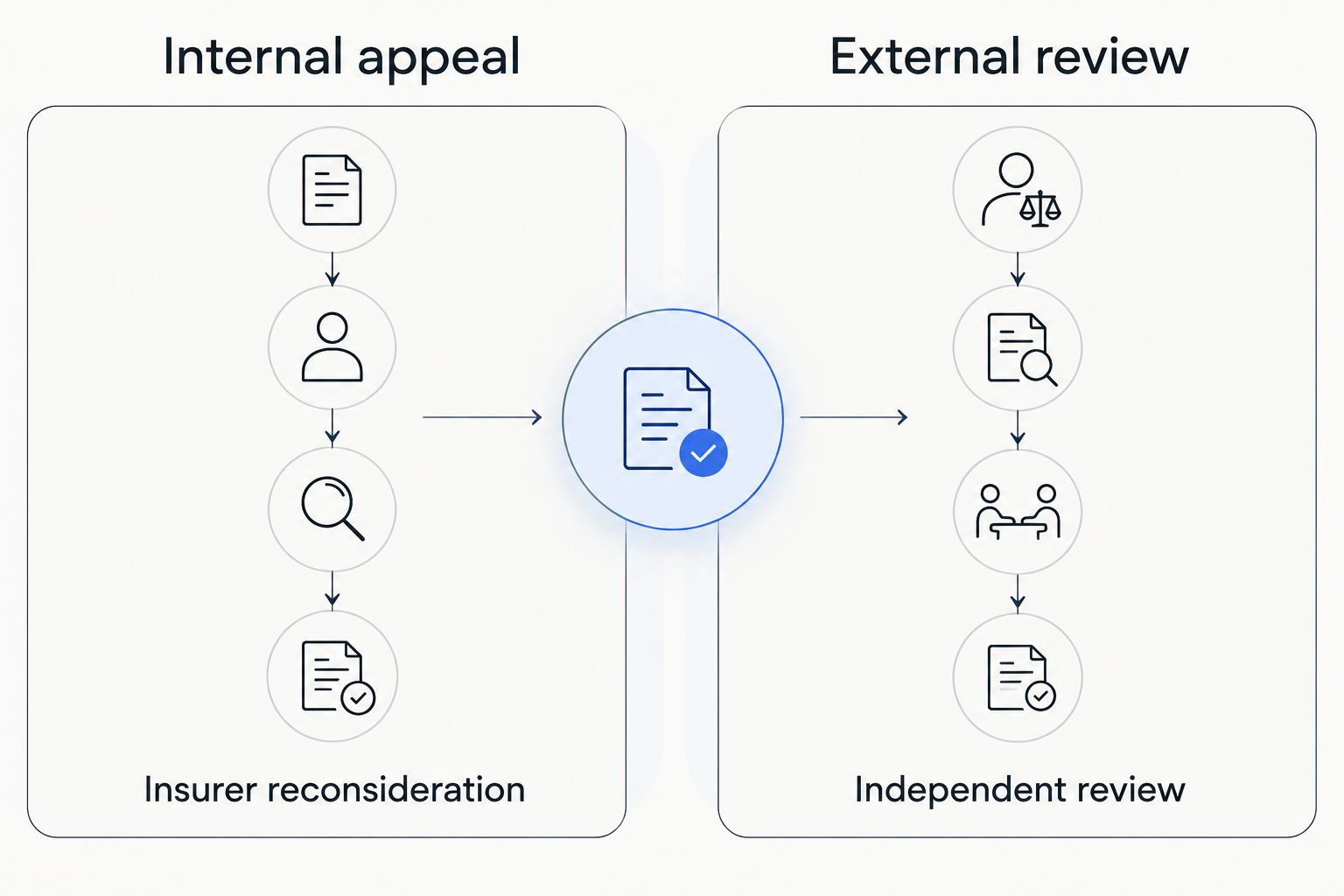
Internal appeals and external reviews serve different functions. Start with the instructions in your denial notice rather than choosing a route based only on your location.
| Review route | Best for | What it does | Main limitation |
|---|---|---|---|
| Internal appeal | Challenging the insurer’s initial decision | Asks the plan or insurer to reconsider the denial | The appeal still operates under the plan’s terms |
| External review | An eligible denial requiring independent review | Sends an eligible dispute to a reviewer outside the insurer | Not every denial qualifies; jurisdiction and deadlines matter |
| Corrected submission | Resolving an identified submission error | Supplies or corrects information through the insurer’s designated process | It does not automatically replace or extend an appeal |
For many health plans subject to federal claims-and-appeals rules, you have at least 180 days to request an internal appeal after receiving a denial. The U.S. Department of Labor's health-benefit claims guidance explains this protection for applicable employer health plans; confirm the rules governing your own coverage.
For an eligible New York external appeal, the New York State Department of Financial Services generally requires a patient application within 4 months of the final adverse determination. This is not a universal deadline for every plan, every denial, or every applicant.
For a denial received in 2026, follow the notice’s instructions and confirm the current requirements with the responsible plan or regulator. Do not calculate your deadline from a general article alone.
Why breast reduction appeal requirements vary
The same operation can produce different insurance decisions because the governing benefits and submitted records differ. These factors determine what your appeal needs:
- Plan terms: Coverage provisions and exclusions define the benefits being considered.
- Denial reason: Missing records, medical necessity, and network restrictions require different responses.
- Clinical documentation: The insurer evaluates the records submitted, not symptoms that were never documented.
- Network benefits: Out-of-network coverage requires its own verification.
- Plan jurisdiction: State-regulated coverage and self-funded employer plans do not necessarily use the same external review system.
- Request stage: A denial before surgery and a claim denial after surgery involve different records and procedural questions.
Ask the insurer to identify your plan type. An insurance company’s name on your card does not establish whether the company insures the benefit or administers a self-funded employer plan.
How do you write a useful appeal letter?
A useful appeal letter connects the denial reason to the supporting record. Keep the argument specific and make the attachments easy to locate.
Identify the decision
Include the patient and member information requested by the insurer, the denial reference, the service under review, and the date of the decision. State whether you are appealing a pre-service request or a processed claim.
Avoid sending sensitive health information through an unverified email address. Use the submission channel identified by the insurer.
Answer the stated reason
Summarize the insurer’s reason accurately, then explain why you are requesting reconsideration. Refer to the relevant plan language or medical criterion and identify the attached evidence supporting your response.
A symptom description and a clinician’s medical assessment serve different purposes. Your account explains your experience; the clinical record supports the medical evaluation.
Request a clear response
Ask for reconsideration and a written decision explaining the outcome. If the insurer maintains the denial, request the next available review instructions and the criteria or documents supporting its decision.
Keep a complete copy of the submission. For a 2026 appeal file, record dates consistently across the denial, correspondence, and delivery confirmation so the sequence remains clear.
What should you ask before an NYC consultation?
Bring the denial notice, insurance card, relevant benefit documents, and available clinical records. Tell the office whether you are seeking an initial evaluation, help understanding an existing denial, or clarification after a claim decision.
Ask how the practice handles benefit verification and what information you need to obtain yourself. Do not assume that a consultation includes representation in every insurance dispute or external appeal.
You can read about the practice before arranging an evaluation. KPS offers breast reduction care, but your surgical suitability and insurance eligibility require separate, patient-specific assessment.
Can you appeal before having breast reduction surgery?
Yes—a pre-service denial can be appealed through the applicable plan process. Confirm whether authorization is required and whether the appeal concerns medical necessity, benefit eligibility, or another issue before deciding how to proceed.
Do not interpret an appeal submission as authorization to undergo surgery. Ask for the insurer’s written decision and discuss unresolved coverage questions before making a surgical commitment.
Does winning an appeal mean insurance pays everything?
No—a successful appeal does not establish that every related expense is payable. Deductibles, coinsurance, network provisions, allowed amounts, and separately billed services can still affect your responsibility under the plan.
Ask what was approved, which providers and services the decision covers, and what conditions remain. Keep the approval alongside the benefit verification rather than treating either document as a complete payment guarantee.
Can your surgeon help with the appeal?
Your surgeon can provide relevant clinical documentation and explain the medical assessment. Ask the office which appeal materials it provides and whether your plan requires permission for someone to act as your representative.
The treating clinician’s role is to document an accurate clinical picture, not to promise an insurer’s decision. KPS does not establish your eligibility simply by offering an insurance-based breast reduction pathway.
FAQ
Can I appeal a breast reduction denial if I have out-of-network benefits?
Yes, you can challenge the denial through the review process available under your plan. Out-of-network benefits do not remove medical-necessity requirements, exclusions, or authorization rules.
How long do I have to appeal a breast reduction denial?
For many plans subject to federal claims-and-appeals rules, you have at least 180 days to request an internal appeal after receiving the denial. Check your notice and confirm the rules for your particular plan.
Can I request a New York external appeal?
You can request a New York external appeal when your coverage and denial meet the state program’s eligibility requirements. Eligible patient applications generally must be filed within 4 months of the final adverse determination; confirm the applicable deadline and process.
What if the insurer says breast reduction is cosmetic?
Ask for the exact policy language and the clinical criteria used to classify the request. An appeal should explain how the documented medical circumstances address those criteria rather than relying only on the procedure’s name.
Do I need to repeat treatment before appealing?
Do not repeat treatment solely because you assume insurance requires it. Obtain the applicable criteria and discuss appropriate care and documentation with your treating clinician.
Is authorization the same as guaranteed reimbursement?
No, authorization is not a guarantee of reimbursement. Payment remains subject to applicable plan terms, eligibility, claim processing, and the scope of the authorization.
One last thing
Ask whether a new submission affects your existing appeal deadline before sending it. Correcting a missing record and formally appealing a denial are not automatically the same action.
For breast reduction planning in 2026, the useful next step is a precise one: identify the denial reason, confirm the governing benefit, and assemble evidence that answers that reason. You do not need a more forceful letter; you need a better-matched submission.
Published by KPS. Author: Not identified. Medical review: No named medical reviewer. This article provides general education, not individualized medical or legal advice.
Related guides